
 111
111 2
2 3
3
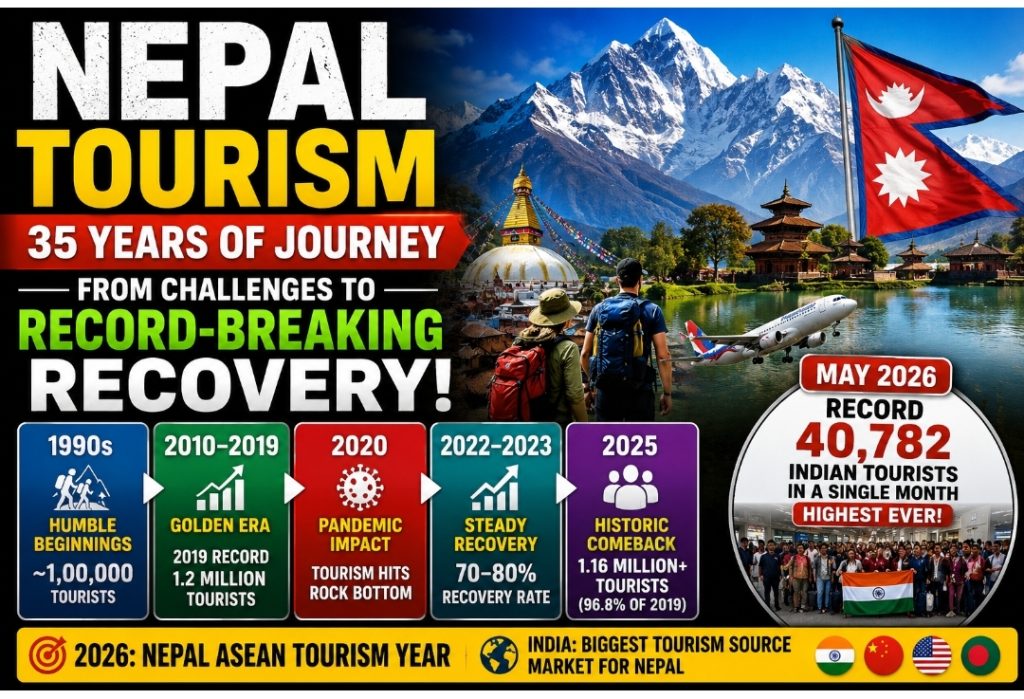
Kathmandu: Nepal’s tourism industry has witnessed an extraordinary transformation over the past 35 years, overcoming political instability, the devastating 2015 earthquake, and the COVID-19 pandemic to emerge stronger than ever. From modest beginnings in the early 1990s to setting new records in 2026, the country’s tourism sector has become a remarkable success story.
In the early 1990s, Nepal welcomed around 100,000 international visitors annually. The country’s breathtaking Himalayan landscapes, Mount Everest expeditions, trekking routes, rich cultural heritage, and spiritual attractions gradually gained worldwide recognition, laying the foundation for a thriving tourism industry.
Nepal experienced rapid tourism growth after 2010. Improved international connectivity, aggressive tourism promotion, and increasing global interest in adventure travel helped drive visitor numbers upward.
In 2018, international arrivals surpassed 1.1 million, while 2019 became the most successful year in Nepal’s tourism history, welcoming nearly 1.2 million foreign tourists.
The global COVID-19 pandemic dealt a severe blow to Nepal’s tourism sector in 2020, reducing international arrivals to historic lows due to worldwide travel restrictions.
Recovery began in 2022 and accelerated through 2023, with tourism rebounding to approximately 70–80% of pre-pandemic levels.
Nepal’s tourism industry staged a remarkable recovery in 2025, welcoming more than 1.16 million international visitors, representing 96.8% of the record-breaking 2019 level. The strong rebound confirmed Nepal’s return as one of South Asia’s leading travel destinations.
Nepal reached another significant achievement in May 2026, when a record 40,782 Indian tourists arrived by air in a single month—the highest monthly figure for Indian visitors in the country’s history.
To further strengthen the sector, the Government of Nepal has declared 2026 as “Nepal ASEAN Tourism Year,” aiming to attract more travelers from Southeast Asian nations and expand Nepal’s global tourism footprint.
India continues to be Nepal’s biggest source of international tourists, followed by China, the United States, and Bangladesh. Tourism experts believe that if the current momentum continues, Nepal is well positioned to surpass its previous records and enter a new era of sustained tourism growth.
Nepal’s 35-year tourism journey stands as a powerful example of resilience, demonstrating how a nation can overcome major crises and build a stronger, more competitive tourism industry through natural beauty, cultural heritage, and strategic development.